
In this story
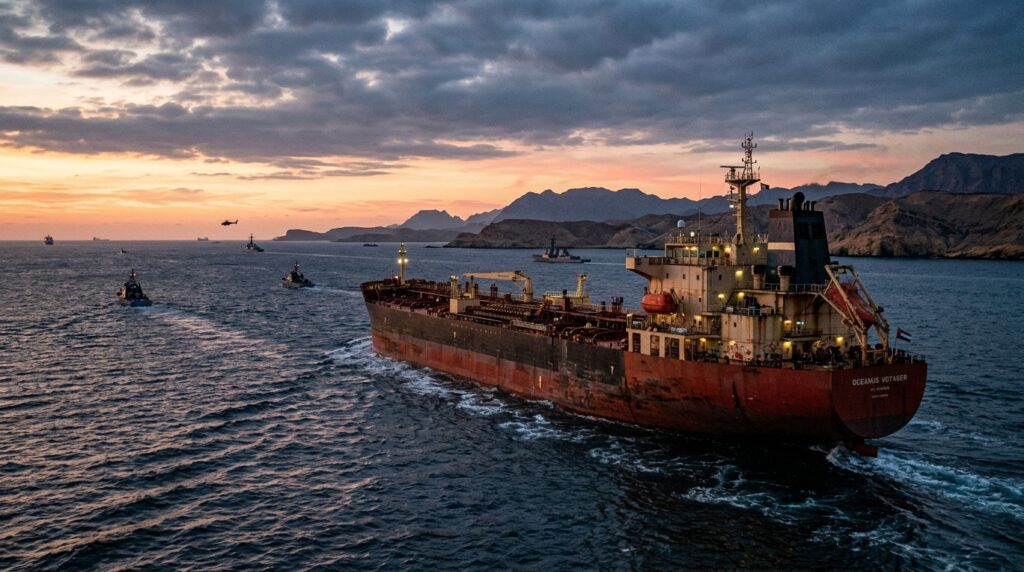
A recent maritime tracking investigation has identified Iranian tankers evading U.S. blockade operations in the Strait of Hormuz, slipping past naval patrols to deliver petroleum and gas shipments to buyers in China. The findings, compiled by the advocacy and investigative organization United Against Nuclear Iran, document how commercial vessels have bypassed maritime restrictions by utilizing an offshore anchorage in Southeast Asia. The naval blockade, reinstated by Washington in mid-July 2026, was intended to sever Iranian port access and stop commercial oil and gas transit out of the Persian Gulf region.
Reporting published on November 2, 2026, by Fox News correspondent Emma Bussey detailed the findings from United Against Nuclear Iran, which showed that at least nine small vessels tied to a clandestine transport fleet have navigated past enforcement lines since the blockade resumed. These small tankers escaped the Gulf of Oman laden with either crude oil or liquefied petroleum gas, highlighting the continuing difficulties of sealing strategic Middle Eastern waterways against specialized shipping operations.
Tracking the SOGL and Offshore Transfer Networks
According to Jemima Shelley, a senior analyst at United Against Nuclear Iran, the tracked vessels made use of coordinated offshore routes to move Iranian hydrocarbons toward East Asia. A primary case documented in the investigation involved the commercial tanker SOGL. Maritime monitoring showed that the SOGL took on a cargo of Iranian liquefied petroleum gas at Assaluyeh Port in late August 2026. By September 1, 2026, the vessel departed the blockade area, carrying an estimated 500,000 barrels of liquefied petroleum gas through the Strait of Hormuz and out into open waters.
Following its departure from the Gulf, the SOGL sailed across the Indian Ocean to the Malaysian Eastern Outer Port Limits Anchorage, an offshore shipping zone located approximately 70 kilometers off the coastline of Malaysia. Fox News reported that the tanker used the anchorage to take on marine fuel and receive technical services before undertaking the final leg of its voyage to discharge the cargo in China. Shelley characterized the Malaysian offshore anchorage as a critical staging ground for Iran’s sanctioned energy trade with China, providing vessels with necessary logistical support outside direct territorial waters.
While the investigation documented the complete voyage of the SOGL, the specific identities and current operational locations of the other eight small tankers identified by United Against Nuclear Iran have not been made public. Neither the U.S. Navy nor the Department of Defense has issued an official confirmation or response regarding the findings. Similarly, authorities in Malaysia and China have not released formal comments regarding the ship-to-ship movements or maritime servicing taking place at the offshore anchorage.
Diplomatic Talks and Military Friction Across 2026
The maritime maneuvers documented by researchers unfolded against a backdrop of intermittent diplomacy, military clashes, and temporary truces between the United States and Iran throughout 2026. Diplomatic contacts occurred across bilateral and mediated channels, even as armed confrontations repeatedly flared in regional waters.
Early signs of these parallel tracks emerged on February 3, 2026, when Bloomberg reported that the U.S. Navy shot down an Iranian drone that had flown close to an American aircraft carrier in the Arabian Sea. Despite that mid-sea interception, President Donald Trump acknowledged that U.S. talks with Iran were actively ongoing. The direct encounter demonstrated how negotiations continued to proceed alongside immediate military friction.
Diplomatic efforts broadened in the spring when Pakistan stepped in to mediate talks in Islamabad. An April 12, 2026, commentary in the Tehran Times by Mir Mohammad Alikhan, an author and former Wall Street banker, noted that the negotiations brought together Iranian Foreign Minister Abbas Araghchi and American envoys Steve Witkoff and Jared Kushner. According to Alikhan, who cited Iranian sources, a primary point of discussion centered on Washington potentially unfreezing approximately $6 billion in Iranian financial assets held in Qatari bank accounts.
The diplomatic discussions in Pakistan coincided with adjustments to military operations on the ground. On April 22, 2026, CBS News journalist Tucker Reals reported that Trump had extended a ceasefire between the parties, even as broader uncertainty persisted over whether the peace negotiations in Islamabad could produce a durable settlement.
Lingering Tensions and U.S. Blockade Enforcement
The cyclical pattern of diplomacy and conflict in 2026 follows years of deteriorating security agreements between Washington and Tehran. Regional diplomatic architecture was long defined by the 2015 Joint Comprehensive Plan of Action, an international nuclear pact monitored by the International Atomic Energy Agency. However, the first Trump administration unilaterally withdrew the United States from the agreement in 2018, initiating an extended era of economic sanctions, military posturing, and shipping disruptions.
Tensions intensified significantly during the intervening years. In his Tehran Times commentary, Alikhan highlighted that the U.S. military launched Operation Midnight Hammer in June 2025, conducting air strikes against Iranian nuclear sites at Fordow, Natanz, and Isfahan while Omani-mediated talks were underway. Alikhan also reported that the United States engaged in joint military operations with Israel during the early months of 2026, further complicating diplomatic prospects leading into the Islamabad sessions.
By early November 2026, the administration maintained a hardline tone regarding its regional posture. In reporting published on November 2, Fox News cited remarks from Trump indicating that the war in Iran would be resolved soon one way or another. In those statements, the president referenced delivering a hammer to Iranian forces and noted that the United States still needed to address one or two remaining targets. Fox News did not specify the setting or broader context surrounding those remarks.
Together, the investigative findings and diplomatic records depict an environment in which naval interdiction and international diplomacy operate side by side. Despite Washington reinstating its naval blockade in mid-July to cut off Iranian maritime trade, small tankers have continued to test enforcement lines, utilizing distant offshore waypoints to sustain energy deliveries to Asian markets.