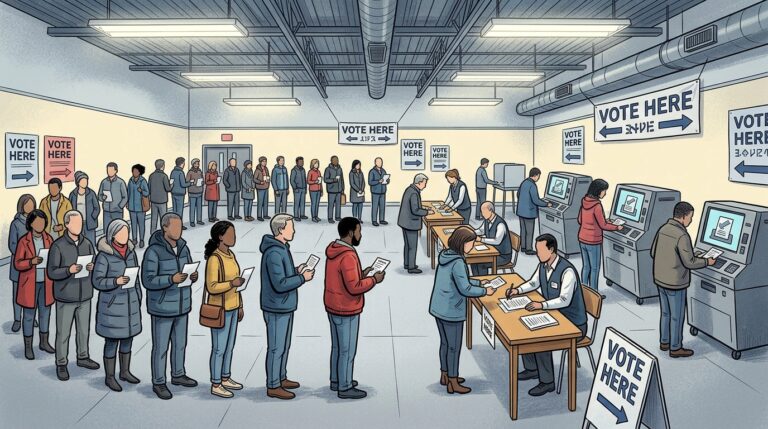

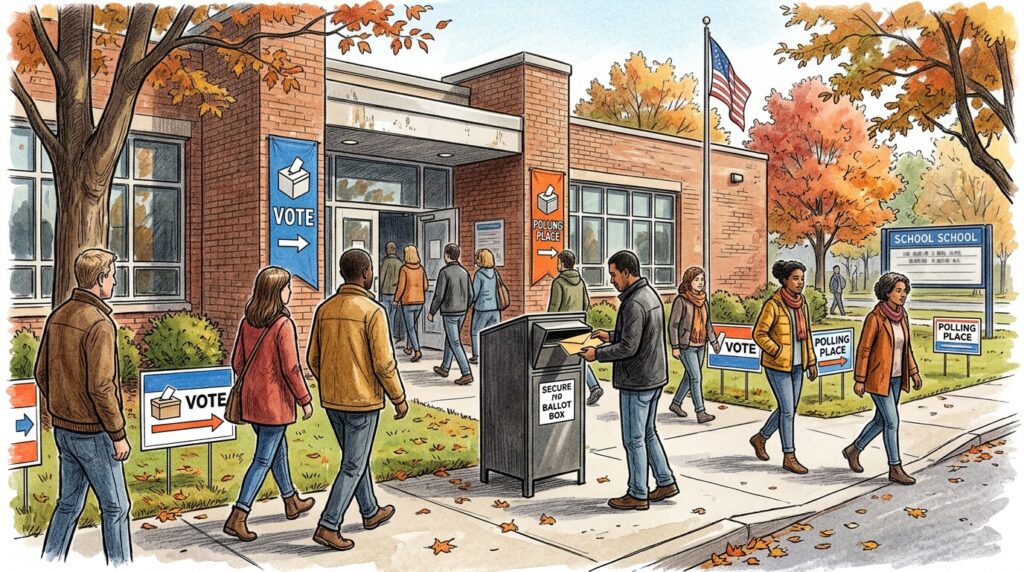
During the 2026 midterm election, political developments unfolded across state ballots and federal law enforcement channels. In Maryland, voters weighed consequential decisions for the governorship, eight seats in the U.S. House of Representatives, several local county executives, and three statewide ballot measures. Simultaneously, election night coverage drew national attention to an ongoing U.S. Department of Justice inquiry regarding candidate recruitment in Alaska’s U.S. Senate race. The convergence of these distinct events highlighted both the mechanics of state balloting and the legal scrutiny surrounding federal campaigns.
## Maryland Gubernatorial and Congressional Contests
At the top of Maryland’s ballot, the gubernatorial election centered on a contest between incumbent Democratic Governor Wes Moore and Republican challenger Dan Cox. Reporting from Bloomberg noted that the Cook Political Report had rated Moore as favored to win reelection heading into the vote. In addition to the two major-party candidates, third-party contenders on the statewide gubernatorial ballot included Andy Ellis of the Green Party and Cathy White of the Working Class Party.
Voters across Maryland were also called upon to decide representation for all eight of the state’s seats in the U.S. House of Representatives. In District 1, Republican Representative Andy Harris stood for election. In District 2, Democratic Representative John Olszewski sought office. The state’s third congressional district featured Democratic Representative Sarah Elfreth, while Democratic Representative Glenn Ivey appeared on the ballot in District 4.
The remaining federal legislative races across the state featured Democratic candidate Adrian Boafo in District 5, Democratic Representative April McClain Delaney in District 6, Democratic Representative Kweisi Mfume in District 7, and Democratic Representative Jamie Raskin in District 8. Alongside these federal races, CBS News reported that Maryland voters were tasked with selecting statewide executive officials for Attorney General and Comptroller.
Local administrative leadership was also on the line across several key jurisdictions. Voters considered candidates for local executive offices in Baltimore, Harford, Anne Arundel, Howard, Montgomery, and Frederick counties. Early digital reporting from CBS News, Bloomberg, and PBS monitored these contests as polls closed, though initial coverage reflected early vote operations with final tallies pending.
## Statewide Ballot Questions and Local Executive Balloting
In addition to candidate elections, Maryland presented three constitutional and statutory measures to voters across the state. Corroborated reports from both CBS News and Bloomberg confirmed that the ballot included Question 3, a proposed constitutional amendment addressing redistricting procedures and the boundaries of electoral districts in Maryland.
CBS News detailed the two other statewide ballot questions before the electorate. Question 1 presented the Arbitration Reform for State Employees Act of 2026, which proposed adjustments to dispute resolution procedures and arbitration standards governing the state workforce. Question 2 concerned temporary appointments on the Commission on Judicial Disabilities, establishing specific protocols for filling interim vacancies and managing oversight within Maryland’s judicial system.
Early news releases from major publishers established live tracking infrastructure to convey returns on these ballot measures as counts progressed. PBS published a live results placeholder page on November 3 at 16:37:20, followed by Bloomberg launching its dedicated Maryland election results map and tracking page at 17:00:00. CBS News published its live report on state races and ballot questions on November 4 at 00:55:03. None of the initial reporting containers included final vote tallies, as polling locations had only recently closed.
## Federal Investigation into the Alaska Senate Election
While state and local returns progressed in Maryland, a separate federal inquiry in Alaska commanded national attention. Reporting from The Washington Post revealed that the Department of Justice initiated an investigation into the recruitment of independent candidate Dan J. Sullivan Jr. in Alaska’s U.S. Senate election. The independent candidate entered the race against incumbent Republican Senator Dan S. Sullivan and Democratic challenger Mary Peltola.
According to an anonymous individual familiar with the federal inquiry cited by The Washington Post, the Department of Justice delivered more than 20 target and preservation letters in connection with the investigation. Federal prosecutors are examining whether Democratic operatives actively recruited Sullivan Jr. to dilute the vote and siphon support away from Senator Dan S. Sullivan. As part of the inquiry, prosecutors are assessing potential civil rights charges tied to the candidate recruitment strategy. Investigators also issued dozens of subpoenas and record-preservation notices requiring the retention and production of communications connected to Sullivan Jr.’s entry into the race.
Among those receiving official correspondence from federal authorities was prominent Democratic election and voting rights attorney Marc Elias, who was issued a target letter. An anonymous Senate Democratic aide reported that on the Sunday preceding the election, Elias had briefed Senate Democrats regarding legal preparations and strategies intended to address potential election interference. In a public statement addressing the matter, Elias asserted that President Donald Trump’s Department of Justice was targeting him and his law firm on Election Day without evidence of wrongdoing, calling the inquiry an effort to weaponize federal authority against political opponents.
## Department of Justice Guidelines and Digital Publishing Discrepancies
Public disclosure of the federal investigation began on the Friday before the election, when Michael J. Heyman, the U.S. Attorney for the District of Alaska, convened a press conference to confirm the active inquiry into candidate recruitment. Heyman announced that every Alaskan deserves a fair election, formally acknowledging the government’s examination of the race.
The timing of the press conference and subsequent notifications prompted scrutiny regarding the Department of Justice’s traditional, unwritten 60-day guideline. Under that internal standard, federal prosecutors typically avoid taking overt, publicized investigative steps in politically sensitive cases within two months of an election to prevent public disclosures from influencing voters.
These two independent storylines crossed paths in digital newsrooms due to a publishing mismatch. On November 4 at 01:08:07, The Washington Post published an article under a headline and URL indicating live updates for Maryland election results. Despite that title, the entire article focused exclusively on the federal investigation into Alaska’s Senate race, Heyman’s press briefing, and the target letters sent by prosecutors. The Washington Post’s text omitted Maryland election results entirely, presenting an editorial contrast to dedicated state coverage published by Bloomberg and CBS News during the same period.