
In this story
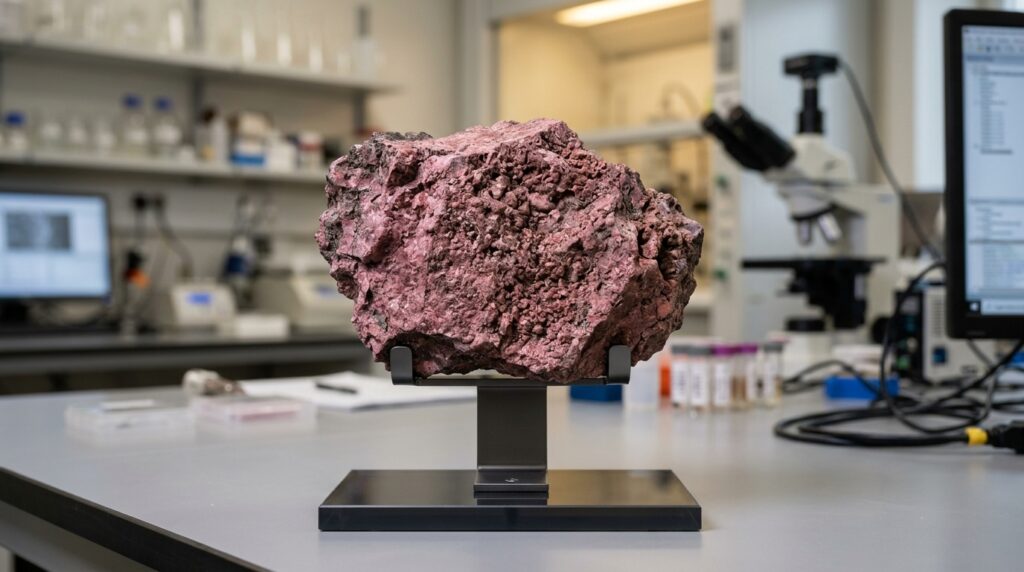
When an unremarkable, 800-gram pink stone was picked up from a salt plain in Mali in 2022, there was little outward sign that it had traveled across the solar system. Laboratory testing soon revealed that the stone was an ancient Martian meteorite that had crystallized more than 4.1 billion years ago. Designated Teghaza 001 after the desert salt plain where it was collected, the specimen is now recognized as one of the three oldest Martian meteorites ever identified on Earth. A NASA-funded study published in the journal Science established that water chemically altered the specimen approximately 4.1 billion years ago, providing tangible physical evidence of an active, dynamic water cycle during Mars’ earliest geological era.
The discovery adds a crucial chapter to the study of planetary evolution. Across global geological collections, scientists have cataloged approximately 435 Martian meteorites, but the overwhelming majority represent volcanic activity from much later periods in the planet’s history. Only three known specimens date back past the 4.1-billion-year mark. While younger Martian rocks record environments that had already dried out and frozen, Teghaza 001 preserves direct physical evidence from a time when the Martian crust was still warm, geologically active, and interacting regularly with liquid surface water.
Uncovering an Ancient Relic in the Sahara Desert
The path from a remote desert find to a landmark scientific publication began when the stone was delivered to researchers at the University of New Mexico. In initial laboratory screenings, scientists analyzed the stone’s oxygen isotopes. Because planetary bodies develop distinct isotopic signatures as they form, measuring the relative proportions of oxygen isotopes allows geochemists to determine where a meteorite originated. The testing conducted at the University of New Mexico confirmed that the 800-gram specimen was a fragment of Mars, distinct from terrestrial rocks and other extraterrestrial materials.
Following that identification, a broader research team that included planetary scientist Yang Liu from NASA’s Jet Propulsion Laboratory examined the specimen in detail. The rock contains primary igneous minerals along with embedded zircon crystals. In planetary geology, zircons are prized as exceptionally durable chronological markers because their internal chemical architecture can endure severe thermal shocks and structural impacts without resetting their isotopic records.
Laboratory Analysis and Dating the Water Alteration
To pinpoint the timing of events preserved within the rock, researchers turned to an advanced analytical technique called in-situ rubidium-strontium dating. Developed with contributions from the California Institute of Technology, this method allows geochemists to analyze individual mineral grains directly inside microscopic sections of a rock rather than dissolving substantial portions of valuable material. According to a report by The Times of India, the sample used for the in-situ dating was smaller than a fingernail, allowing researchers to gather precise chronological measurements while keeping almost the entire 800-gram mass intact for future examination.
The isotopic measurements demonstrated that liquid water altered the rock approximately 4.1 billion years ago. Because the mineral alteration occurred at that date, the primary igneous minerals and zircons within the meteorite must have formed even earlier. The findings show that aqueous fluids circulated through the early Martian crust, reacting with volcanic rock and leaving behind clear mineral alteration markers. Study co-author Lee Saper, who carried out research on the meteorite as a postdoctoral scholar at the Jet Propulsion Laboratory, noted that the rock provides an extraordinary sample of Martian crust from a region not previously represented in terrestrial meteorite collections. Saper pointed out that the stone preserves evidence of water-rock interactions and could retain traces of the early Martian atmosphere from the critical period when the planet was beginning to lose its water inventory.
Tracing the Meteorite’s Origins to the Southern Highlands
Connecting a meteorite found on Earth to a specific region on another planet requires cross-referencing laboratory measurements with remote planetary observations. Teghaza 001 was dislodged from Mars when a major surface impact excavated a section of bedrock and hurled it into interplanetary space. The rock drifted through space until intersecting Earth’s orbit, entering the atmosphere, and settling in the Sahara Desert.
To identify where on Mars the rock originated, the research team compared its chemistry and mineral composition with spectroscopic data collected by NASA’s Mars Reconnaissance Orbiter. By matching orbital mineral maps with laboratory measurements, the researchers narrowed down the rock’s potential source to 13 candidate sites across the planet. The vast majority of these candidate locations are situated in the heavily cratered southern highlands of Mars, a battered expanse that preserves the planet’s oldest exposed crust. Although the specific impact crater responsible for blasting Teghaza 001 into space has not been definitively identified, the concentration of matching sites points toward these ancient highland terrains.
Context Within Martian Exploration and Geological Records
The publication of the research in Science followed complementary investigations into the meteorite. In June 2026, a separate study focused specifically on the rock’s water content was published in Science Advances, as reported by The Times of India. NASA subsequently detailed the broader findings regarding the rock’s age, mineral alteration, and candidate source locations in a formal report released on October 29, 2026.
While robotic rovers and orbital sensors continue to collect data across the surface of Mars, laboratory analysis of returned or delivered rocks remains an essential pillar of planetary science. High-precision instruments on Earth can detect subtle isotopic variations and isolate individual crystal grains in ways that current spacecraft cannot match. As one of only three Martian meteorites on Earth that date back more than 4.1 billion years, Teghaza 001 provides a tangible baseline for understanding the early planetary conditions under which Martian water flowed, weathered the crust, and gradually diminished.