
In this story
Voters across the country cast ballots on Tuesday, November 3, 2026, in the 2026 midterm elections, deciding a high-stakes national contest that will set the legislative direction in Washington for the remainder of President Donald Trump’s term. With control of Capitol Hill hanging on razor-thin majorities, the vote encompassed all 435 seats in the U.S. House of Representatives and 35 seats in the U.S. Senate, along with 36 gubernatorial races across the nation. Republicans entered Election Day defending narrow advantages in both congressional chambers, while Democrats sought a handful of decisive flips to reclaim leadership.
Tight Margins in the Battle for Congress
Heading into the election, Republicans held a 53-47 majority in the Senate. Because of that six-seat gap, Democratic hopes of capturing the upper chamber required a net pickup of four seats without dropping any of their own contested territory. The political arithmetic proved just as demanding in the House of Representatives, where Republicans held a fragile edge and Democrats needed a net gain of three seats to win back the speaker’s gavel.
That balance spurred unprecedented financial investments across competitive districts and statewide campaigns. Technology executive Elon Musk poured $474 million into Republican candidates, allied committees, and affiliated conservative groups during the election cycle. At the same time, major political donors connected to the Rockbridge Network, a conservative political group co-founded by Vice President JD Vance, arranged a private gathering in the Houston area beginning the following weekend to assess the post-election landscape and chart their future priorities.
Key Senate Contests Across the Country
The campaign for the Senate played out over an intricate national map marked by retirements, open seats, and unusual political developments. In Michigan, Democratic nominee Dr. Abdul El-Sayed faced Republican Mike Rogers in a critical open-seat contest. The race saw an unexpected shift just two days before voters went to the polls, when Democratic Representative Haley Stevens crossed party lines on Sunday to endorse Rogers over El-Sayed.
In Texas, Democratic state Representative James Talarico campaigned against Republican Attorney General Ken Paxton, seeking to pull off an upset in a state where Democrats have long struggled to win statewide office. In Maine, longtime Republican Senator Susan Collins faced a stiff re-election challenge from Troy Jackson, the former Democratic president of the Maine state Senate. In Georgia, another high-profile defensive battle unfolded as Democratic Senator Jon Ossoff defended his seat against Republican Representative Mike Collins.
Unplanned vacancies and short-term appointments also reshuffled several key races. In South Carolina, veteran Republican Senator Lindsey Graham died in July 2026, leading to the appointment of his sister, Darline Graham, to fill the vacancy. She defended the seat on Tuesday against Democratic nominee Dr. Annie Andrews. In North Carolina, former Democratic Governor Roy Cooper ran against Republican nominee Michael Whatley for the open seat created by the retirement of Republican Senator Thom Tillis.
In Ohio, former Democratic Senator Sherrod Brown attempted a political comeback by running against Republican Senator Jon Husted to serve out the remainder of the Senate term originally won by Vice President JD Vance. Other contested Senate seats included Florida, where Republican Senator Ashley Moody faced Democratic challenger Angie Nixon, and New Hampshire, where Democratic Representative Chris Pappas ran against Republican former Senator John Sununu.
Equipment Problems, Court Rulings, and Federal Inquiries
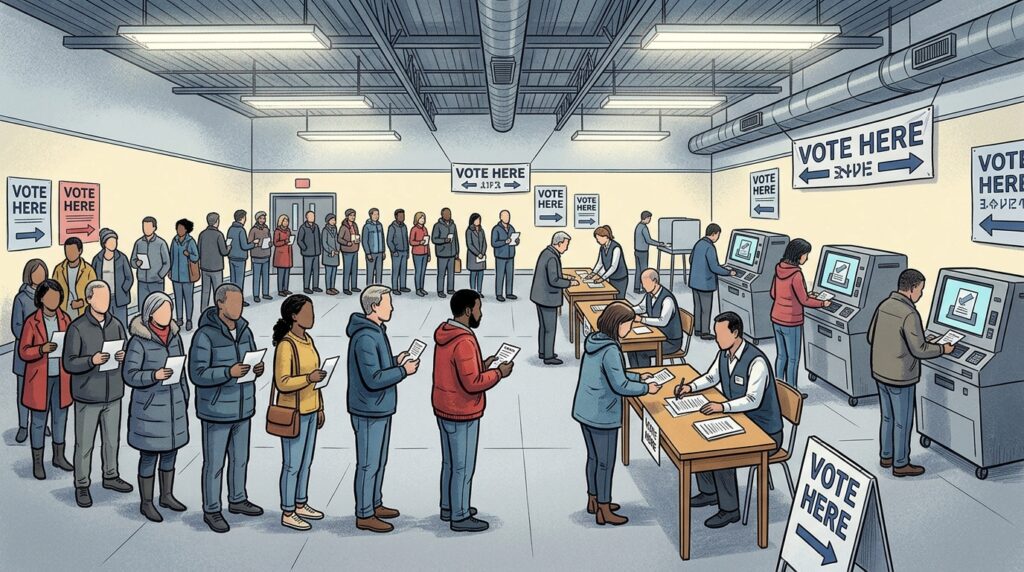
Voting operations ran smoothly across most of the country on Tuesday, but isolated equipment malfunctions, legal rulings, and federal inquiries quickly drew attention. In Westchester County, New York, paper ballot scanning machines failed at several voting locations during the morning hours. Poll workers responded by deploying established emergency backup procedures, directing voters to deposit completed paper ballots into secure protocol bags for later tabulation.
Election authorities moved quickly to reassure the public that the process remained safe. Kathleen R. McGrath, a spokeswoman for the New York State Board of Elections, confirmed that official contingency plans exist specifically to handle scanning equipment failures without disrupting voting. In Westchester County, Democratic Election Commissioner Tajian M. Nelson and Republican Election Commissioner Douglas A. Colety confirmed that all deposited paper ballots were secure and would be tabulated. Derek Tisler, an election policy expert at the Brennan Center for Justice, observed that technical hiccups of this nature fall well within the range of operational issues that election administrators routinely prepare to manage.
The scanner failures coincided with a closely watched congressional race in New York’s 17th Congressional District, where incumbent Republican Representative Mike Lawler faced Democratic challenger Cait Conley. With voting lines slowing at several polling sites, both candidates took to social media to urge their supporters to remain patient. Lawler advised constituents to remain in line and assured them that every ballot would be counted, while Conley urged voters not to allow the delays to dissuade them from making their voices heard. New York Attorney General Letitia James also monitored the voting process across the area.
High-stakes legal fights reached the federal courts as voting took place. On Tuesday morning, the U.S. Supreme Court denied an emergency request from the Trump administration that sought to set aside 20,000 mail-in ballots in California over claims involving noncitizen voting. In response to the decision, a Justice Department spokesperson expressed disappointment with the high court’s refusal to intervene and announced that federal monitors would be dispatched to observe polling places.
At the same time, federal law enforcement scrutinized the Senate election in Alaska, where incumbent Republican Senator Dan Sullivan faced Democratic challenger Mary Peltola alongside an independent candidate, a retired schoolteacher also named Daniel J. Sullivan. The Justice Department sent roughly 20 target letters in a criminal investigation examining allegations of donor fraud and conspiracy related to the recruitment of the similarly named candidate. The inquiry focused on several individuals, including Democratic election lawyer Marc Elias and an official at the Democratic Senatorial Campaign Committee. For its part, the Peltola campaign rejected claims that it had played any role in recruiting the alternate candidate to siphon votes from the incumbent.
House Battlegrounds and Voting Timelines
Beyond the fight in suburban New York, several competitive House districts across the West drew national attention. In Colorado’s 1st Congressional District, 29-year-old Democratic candidate Melat Kiros was favored to become the first member of Generation Z elected to Congress after defeating longtime incumbent Representative Diana DeGette in the Democratic primary. In Colorado’s 4th Congressional District, Republican Representative Lauren Boebert mounted a defense of her seat against Democratic challenger Eileen Laubacher.
Voting schedules stretched across multiple time zones throughout Tuesday. The nation’s first polling locations opened at 5:00 a.m. in Vermont. Polls opened an hour later, at 6:00 a.m., in New York, New Jersey, Virginia, Connecticut, Kentucky, and parts of Georgia, Florida, and Pennsylvania. The earliest poll closings came at 6:00 p.m. Eastern Time in parts of Indiana and Kentucky, while the final polling stations in the country closed in Alaska at 1:00 a.m. Eastern Time on Wednesday, November 4, 2026.