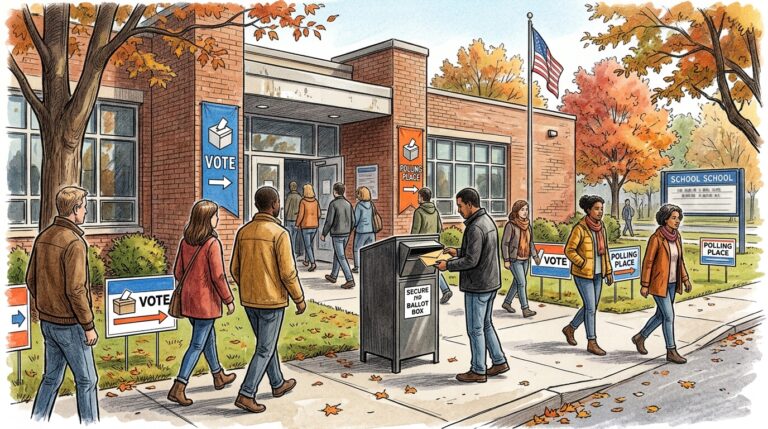

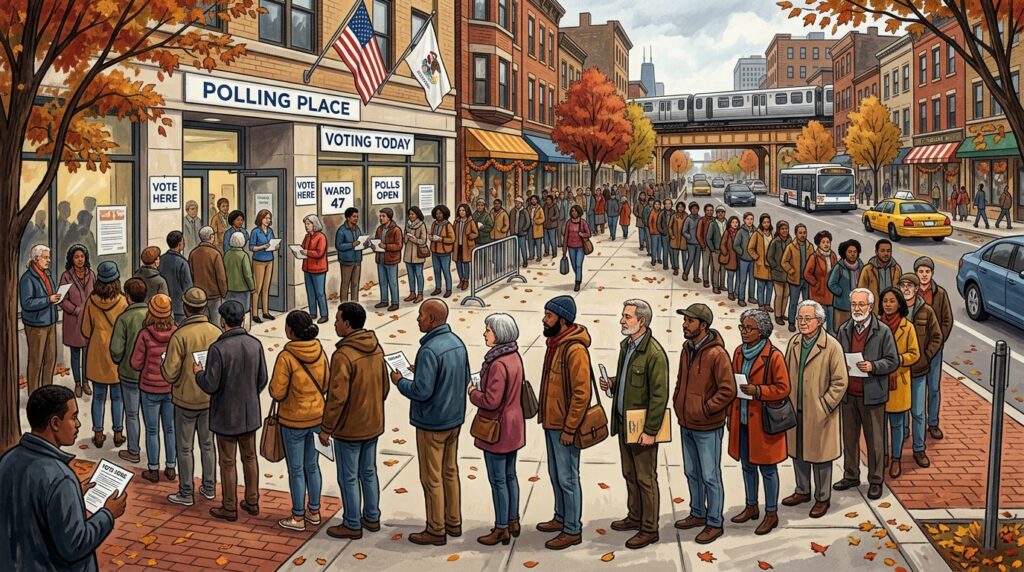
Voters across Chicago encountered severe disruption during the Tuesday, November 3, 2026 general midterm election as widespread paper ballot shortages left polling stations without basic paper supplies, creating lines that extended several city blocks. The logistical shortfalls appeared early in the morning and escalated through the afternoon, forcing election judges at numerous precincts to direct hundreds of arriving citizens toward a small number of electronic voting terminals. The resulting logjam created multi-hour delays for voters across the North, West, and South sides.
The Chicago Board of Elections acknowledged the mounting problem as supplies dwindled across multiple wards. Julie Metea, serving as interim spokesperson for the election board, confirmed that agency staff responded by printing supplemental paper ballots at the downtown warehouse to restock depleted polling places across the city. Under municipal voting regulations, election authorities reiterated that any eligible voter who joined the queue before the official 7:00 p.m. poll-closing time would be allowed to cast a ballot, regardless of how long the lines took to clear.
## Morning Ballot Deficits Across Neighborhood Precincts
Election workers and poll volunteers began arriving at their assigned polling sites at approximately 6:00 a.m. to prepare equipment for the morning rush, but several locations ran out of physical ballots almost immediately after opening. At Goudy Elementary School in the 48th Ward, which is represented by Alderman Leni Manaa-Hoppenworth, paper ballots were exhausted entirely by 8:15 a.m. Adam Honaker, an election judge assigned to Goudy Elementary, reported that poll workers there had initially received a starting allocation of only 50 paper ballots. Goethe Elementary School in Logan Square encountered an identical shortfall, running through its initial paper stock by that same 8:15 a.m. mark.
Between 9:00 a.m. and 10:00 a.m., similar ballot deficits spread to other key neighborhood locations. Polling sites operating at Manuel Perez Jr. Elementary School, Holstein Park, and two separate precincts housed together inside Goethe Elementary quickly exhausted their printed inventories. Over the course of the morning, the supply failures affected voting locations across multiple major neighborhoods, including Logan Square, Pilsen, Uptown, Albany Park, and the Near West Side.
Emergency replenishment deliveries struggled to keep pace with voter demand as the day advanced. Goethe Elementary ran out of paper ballots for a second time at approximately 2:30 p.m. Over in Pilsen at Manuel Perez Jr. Elementary School, election judge Jesus Fraga watched the site exhaust its paper supplies for a second time between 3:00 p.m. and 3:20 p.m. Meanwhile, at Holstein Park, election workers received a supplementary delivery of only 50 paper ballots, which did little to alleviate congestion. By 5:00 p.m., voters waiting outside Holstein Park reported queue times of at least two hours.
## Split Precinct Complications and Central Supersite Congestion
The Chicago Board of Elections received its earliest formal notification of the shortages from the 1st Ward around 10:00 a.m. Metea explained that the agency focused its operational review on split precincts, where local boundaries intersect multiple political districts. These complex precincts require up to seven distinct ballot styles to accommodate different variations of local, state, and school board races.
The consequences of this administrative distribution were clearly visible at Roosevelt High School in Albany Park. Election judge Kim Smolen tracked a severe allocation disparity between competing districts assigned to the school. While the precinct was sent 1,700 paper ballots for school board district 2B, it received only 150 ballots for school board district 3A. That smaller allotment for district 3A was completely gone by 11:30 a.m., leaving those specific voters entirely dependent on the few electronic terminals in the room until replacement paper ballots arrived around 3:00 p.m.
Other locations saw emergency shipments arrive during the same mid-afternoon period. At the Noble Square Cooperative, election judge Dan Doyen noted that supplemental ballots finally reached election judges between 3:00 p.m. and 3:20 p.m.
Voters who bypassed local precinct stations in favor of centralized facilities found little relief from the overcrowding. At the downtown Chicago voting super site located at 137 S. State St., voter lines stretched outside the building and wrapped around multiple downtown blocks. By 3:30 p.m., individuals waiting at the downtown super site faced estimated delays of roughly two hours and ten minutes to cast their ballots.
## Turnout Patterns and Growing Community Frustration
The persistent delays triggered sharp criticism from ward officials and affected community members throughout the afternoon. Alderman Daniel La Spata of the 1st Ward contended that high voter turnout alone could not justify neighborhood precincts running out of printed ballots before 9:00 a.m. In the 32nd Ward, Democratic Committeeman Mike Nellis argued that election administrators should have anticipated robust turnout, pointing toward the elevated national political climate and public interest in Chicago’s school board elections, which featured candidates such as incumbent Carlos Rivas Jr.
For many residents, the multi-hour wait times disrupted tight work schedules and family responsibilities. Jenna Roggensack, a local school teacher voting in Logan Square, was initially turned away and advised to come back later due to ballot shortages. When Roggensack returned later in the day, she waited an additional hour and a half before finally casting her ballot. Another Logan Square voter, Grace DeVies, noted that the prolonged delays and ballot deficits functioned as voter suppression in practice, observing that people with disabilities, hourly workers, and residents with urgent caregiving obligations simply had to leave the lines without participating.
Turnout data indicated steady in-person participation throughout the afternoon. Figures from the Chicago Board of Elections cited by AOL recorded that citywide turnout climbed past 180,000 by 2:30 p.m. Additional data reported by Block Club Chicago showed that by 3:15 p.m., 232,672 in-person ballots had been cast across neighborhood polling stations. That 3:15 p.m. level surpassed the approximately 227,633 Election Day ballots cast by a comparable time during the 2022 midterm election.
## Similar Ballot Shortfalls at a Kansas Polling Location
Supply deficits were not entirely limited to Chicago polling places on November 3, 2026. A comparable ballot shortage emerged in Leavenworth County, Kansas, at the Linwood Community Building.
According to reporting from Hoodline citing KCTV5, the Linwood polling place ran out of paper ballots for Kansas House District 38 on Tuesday morning, stranding dozens of area voters in lines for more than an hour. The Leavenworth County Election Office admitted that the disruption stemmed from an administrative error in calculating the required ballot order for the precinct. To resolve the deficit, county staff printed 200 replacement ballots and drove them on a 45-minute route from the county election office out to Linwood, while printing an additional 800 backup ballots to hold in reserve for the remainder of the day.