

In this story
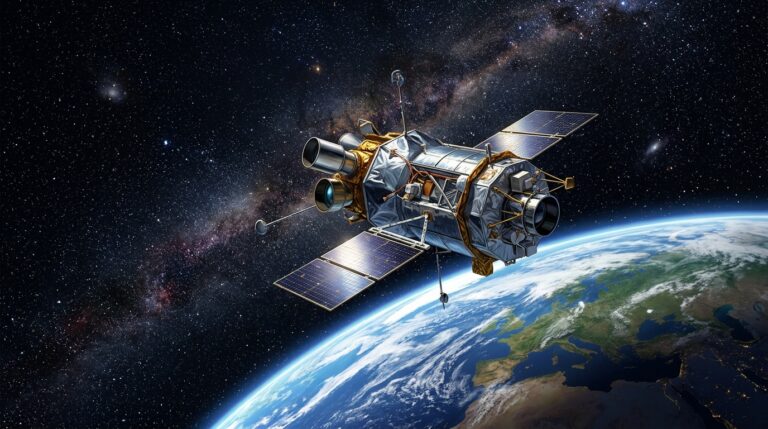
The NASA Swift space telescope has re-entered Earth’s atmosphere and crashed back to the planet, concluding more than two decades of cosmic observation after a commercial mission to save the spacecraft ended in failure. Data from tracking networks confirmed that heightened solar activity over recent years had steadily eaten away at the spacecraft’s orbital altitude, pulling the minibus-sized observatory downward into dense atmospheric layers where its mission came to an unceremonious end.
Military tracking units verified that the satellite reached its terminal descent point near Sumatra, Indonesia. The uncontrolled plunge brought a dramatic finish to a spacecraft that spent 22 years studying some of the most violent and luminous explosions in deep space, while also underscoring the severe operational difficulties private aerospace firms face when attempting complex orbital salvages on aging scientific hardware.
Tracking the Re-Entry Near Sumatra
Official confirmation of the satellite’s fiery final descent was provided by the US Space Force, which tracked the spacecraft as its trajectory plunged into the upper atmosphere near Sumatra. According to military data, the re-entry took place on November 4, 2026, at 12:39 UTC, which corresponded to 11:39 p.m. Australian Eastern Daylight Time. Tracking officials noted that natural atmospheric drag, greatly exacerbated by ongoing solar activity, was the direct driver behind the spacecraft’s gradual orbital decay and eventual demise.
The concluding days of Swift’s descent were marked by conflicting timelines across major news reports. On October 31, 2026, at 13:03:00, AP News published an alert reporting that the observatory was on the verge of plunging back to Earth. Several days later, on November 3, 2026, The New York Times published a report stating that a NASA telescope had crashed back to Earth. That published account stood in sharp contrast with the formal event log verified by the US Space Force, which recorded the actual atmospheric entry on November 4.
The physical composition and scale of the spacecraft shaped how it broke apart during descent. The observatory carried an estimated mass of approximately 1.5 tonnes, a figure cited by Michael Wall, spaceflight and tech editor at Space.com, as roughly 3,200 pounds. In terms of overall physical dimensions, the platform was roughly the size of a minibus. NASA engineers had anticipated that while extreme thermal friction would incinerate the majority of the satellite as it tore through the upper atmosphere, some of the denser structural components would likely survive the extreme heating and reach the surface.
Even so, substantial questions remain regarding the final debris footprint. It is currently unknown precisely how much of the vehicle survived atmospheric re-entry, whether any fragments remained intact upon reaching land or water, or where any potential impact debris might be distributed across the region.
Two Decades of High-Energy Astrophysics
The destructive re-entry concluded an operational life that vastly surpassed initial expectations. NASA launched the Swift mission in 2004 with a planned baseline lifespan of just two years. Its primary scientific mandate focused on identifying and analyzing gamma-ray bursts—the most energetic and luminous explosions known in the universe—while also tracking the rapid behavior of exploding stars.
Rather than going dark after completing its mandatory 24-month operational period, the observatory continued returning valuable data for 22 years. In total, the spacecraft endured 11 times longer than mission planners had initially projected. Over those decades, Swift established itself as an indispensable asset for astronomers worldwide, detecting transient astronomical phenomena and quickly relaying positional coordinates to ground observatories and other space instruments.
However, the physical realities of low Earth orbit eventually proved insurmountable for the aging platform. Intense solar activity recorded over the past few years expanded Earth’s outer atmosphere, increasing aerodynamic drag on satellites operating at Swift’s orbital altitude. That heightened drag progressively sapped the spacecraft’s momentum, accelerating its downward spiral toward the denser atmosphere below.
The Failed Katalyst Space Salvage Effort
As the spacecraft’s altitude degraded at an unsustainable pace, NASA turned to the private commercial sector in an effort to save the platform. The space agency contracted Katalyst Space, a commercial aerospace company, to conduct an orbital boost mission intended to elevate the telescope into a safer, higher operational orbit.
To carry out the mission, Katalyst Space designed and built a specialized three-armed robotic spacecraft engineered to rendezvous with Swift and physically raise its orbital altitude. The rescue vehicle launched in July 2026 to begin its intercept flight. However, the robotic craft encountered serious technical trouble during its launch sequence. While the specific technical cause of the launch failure has not been disclosed, the robotic vehicle was unable to carry out its docking objectives. The salvage effort ended in complete failure when the rescue craft itself crashed in September 2026.
The loss of the Katalyst Space craft eliminated the only available contingency plan to save the observatory. With no other commercial or government salvage missions available to mount another intercept before Swift reached the lower atmosphere, NASA had no viable alternative to stabilize the spacecraft, leaving tracking stations to monitor its uncontrolled descent.
Implications for the Hubble Space Telescope
The loss of the Swift observatory has prompted wider discussions within NASA regarding the preservation of other flagship scientific platforms, most notably the Hubble Space Telescope. Hubble was deployed into low Earth orbit in 1990 and remains exposed to the same atmospheric drag that brought down Swift.
Recent orbital analyses project that without an active intervention, Hubble’s orbit will degrade toward atmospheric re-entry by the mid-2030s. To prevent an uncontrolled loss, NASA has been assessing private-sector proposals to rescue, re-boost, or conduct a controlled re-entry of the historic telescope. Space agency timelines indicate that any proposed commercial salvage or boosting mission must take place by 2032 to avoid an irreversible descent.
NASA leadership has acknowledged the logistical challenges involved while reiterating Hubble’s ongoing scientific relevance. NASA Administrator Jared Isaacman has stated that Hubble still has critical science ahead of it, emphasizing that the agency should evaluate every reasonable path to keep the telescope operational for as long as possible. Meanwhile, NASA science mission chief Nicky Fox pointed out that the space agency enjoys considerably more time to evaluate potential rescue plans for Hubble, contrasting that multi-year planning horizon with the rushed emergency operation that characterized the unsuccessful rescue mission for Swift.