
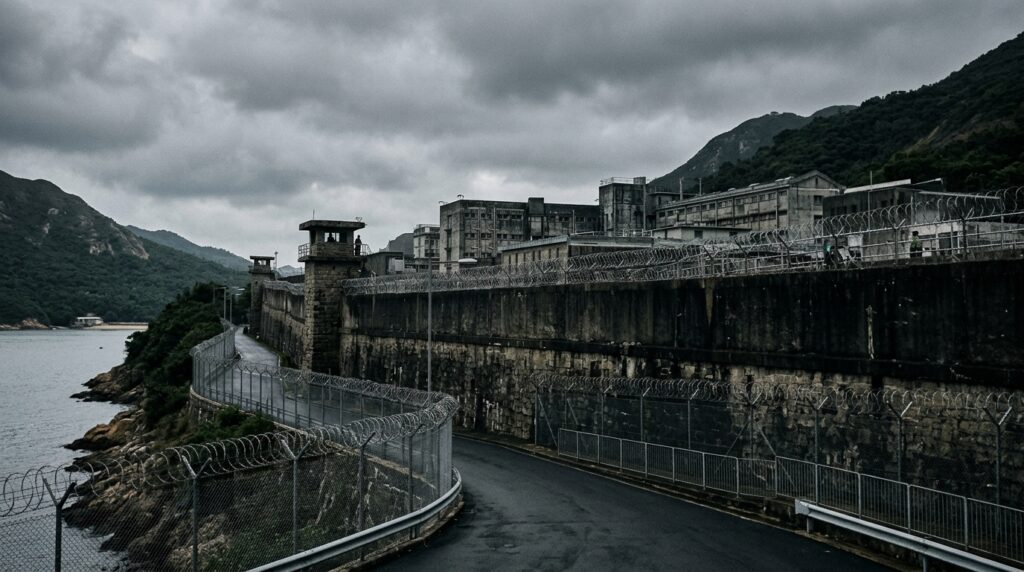
A prominent Hong Kong activist has warned that international attention on his home territory is steadily slipping away as great-power competition dominates the global stage. Joshua Wong, who is 30 years old, shared those concerns in personal correspondence sent from Stanley Prison, where he has remained locked in confinement since November 2020. The recent Joshua Wong prison sentence of 10 years followed a guilty plea entered in September to a foreign collusion charge under local national security legislation, extending his stay inside the oldest maximum security penitentiary in Hong Kong.
The letters, penned between August and October and reviewed by The Guardian, offer a rare, sustained look at how one of the city’s best-known campaigners manages extended isolation. Facing another decade in custody, Wong reflected on the quiet fear that the outside world is gradually turning its attention elsewhere, leaving behind both Hong Kong and the ordinary residents who sacrificed their personal freedom for their political principles during a period of sweeping geopolitical change.
## Maximum Security Confinement and Legal History
Wong stands as the only pro-democracy campaigner in Hong Kong to face two separate prosecutions under the territory’s national security laws. Before the latest indictment, correctional authorities had scheduled him to walk free in January. That planned release was erased after his conviction in November on the foreign collusion charge, which resulted in the 10-year prison term. The presiding court ordered that his earlier sentence and his newly handed-down penalty will run concurrently.
Because of repeated legal actions and persistent detentions over the past decade, Wong has spent multiple major milestones separated from the public and his family. Over the course of his successive terms in custody, he has marked his 21st, 25th, and 30th birthdays behind prison walls. His continuous confinement inside Stanley Prison has kept him completely separated from the civic stage where he first made a name for himself as a student organizer.
The circumstances and timing of this secondary prosecution have sparked strong condemnation from fellow campaigners living abroad. Frances Hui, a childhood friend of Wong who now works as an exiled pro-democracy activist, described the government’s renewed legal offensive as a deliberate push to control and reshape the public memory of an entire political generation. Hui pointed out that Hong Kong authorities allowed nearly five years to elapse following the alleged offenses before initiating the prosecution, choosing to bring the foreign collusion charge just as Wong was approaching his expected release date.
## Daily Life, Prison Culture, and Social Interactions
Confined within a tightly managed maximum security institution, Wong has attempted to build personal stability through regular exercise, reading, and close observation of custodial life. In his correspondence, he described undergoing noticeable weight loss while keeping up with an exacting physical workout routine centered on daily sets of pushups, pull-ups, and squats inside his cell.
His interactions behind bars span an eclectic mix of fellow inmates serving time in Stanley Prison. Wong reported that he frequently exchanges books with incarcerated Triad members, noting that veteran triad bosses had shared reading material with him, including Mario Puzo’s novel about the Corleone crime family. He also paid close attention to the informal subcultures that sustain life inside the facility, recording that younger prisoners commonly rely on packages of M&Ms candies as an everyday alternative currency to conduct internal trades and settle favors.
Other connections within the prison compound have crossed linguistic and cultural boundaries. Wong wrote that he provided regular English instruction to a Russian inmate. When trying to convey the definition of totalitarian governance during their tutoring sessions, Wong used the name of Russian leader Vladimir Putin as his direct illustrative example.
## Reading, Academic Work, and Intermediaries to the Outside World
To keep his mind active through prolonged stretches of isolation, Wong took up the academic study of company law. His decision to pursue legal coursework was directly inspired by the biography of former South African president Nelson Mandela, who studied law during his decades as a political prisoner.
Wong’s personal reading list in Stanley Prison has also touched on recent global memoirs and economic analysis. His letters reveal that he completed Alexei Navalny’s posthumous memoir, Patriot, following the late Russian opposition figure’s personal history. He also read through the published memoir of Gary Stevenson, as well as JD Vance’s bestselling biographical account of Appalachian life, Hillbilly Elegy.
Reading Vance’s memoir coincided with Wong’s efforts to keep track of shifting political dynamics across the Pacific. In November 2024, he followed news of the United States presidential election as closely as institutional limitations permitted. Because inmates in Hong Kong correctional facilities are denied direct internet access, Wong turned to visiting friends to act as technical and informational liaisons. He routinely asked those visitors to submit research questions to artificial intelligence chatbots on his behalf and instructed them to bring or print social media screenshots so he could follow ongoing conversations online.
## Hong Kong’s Transformed Civic Environment
Wong’s current isolation inside a maximum security cell contrasts sharply with his early public visibility. He first achieved international recognition as a teenage leader during the 2014 Umbrella movement, an effort that brought him global attention and landed his portrait on the international cover of Time magazine in October 2014. Five years later, in 2019, massive demonstrations erupted across the territory over a contentious extradition bill while Wong was serving a prison term tied to his earlier 2014 demonstration role. Upon completing that sentence, he joined the ongoing protests on the streets.
The civic environment changed fundamentally in 2020 when Beijing enacted the national security law over Hong Kong. Officials in Beijing defended the sweeping security framework as a vital measure required to restore institutional stability and social order following months of disruptive street demonstrations. In the years following its passage, the statutory framework has altered the territory’s civic and judicial landscape, resulting in more than 400 arrests overseen by local law enforcement, according to public tracking figures provided by the Hong Kong Security Bureau.
These lasting changes have led to somber conclusions among those who once organized alongside Wong. An unnamed childhood friend who spoke anonymously reflected that the specific Hong Kong they had mobilized to protect no longer exists, remarking that it remains difficult to judge whether the passage of time favors the authorities or the movement that once challenged them.